Thermal vs Carbonless (NCR) vs Fax Paper Rolls: A Buyer's Guide for Malaysian Businesses
Paper rolls look simple. They are just long strips of paper wound around a small tube. But if you have ever loaded the wrong roll into a cash register, you know how quickly things go wrong. The printer stays blank, the customer waits, and the queue grows.
The truth is that paper rolls come in very different types, and each one works in a different way. This guide explains the three most common types: thermal, carbonless (also called NCR) and fax rolls. You will learn how each one works, which machines need it, and what to check before you buy.
Thermal paper has a special coating on one side. When the printer's print head heats a spot on the paper, the coating changes colour and turns dark. That is how the text appears. No ink, ribbon or toner is needed.
Paper rolls look simple. They are just long strips of paper wound around a small tube. But if you have ever loaded the wrong roll into a cash register, you know how quickly things go wrong. The printer stays blank, the customer waits, and the queue grows.
The truth is that paper rolls come in very different types, and each one works in a different way. This guide explains the three most common types: thermal, carbonless (also called NCR) and fax rolls. You will learn how each one works, which machines need it, and what to check before you buy.
Thermal Paper Rolls
How it works
Thermal paper has a special coating on one side. When the printer's print head heats a spot on the paper, the coating changes colour and turns dark. That is how the text appears. No ink, ribbon or toner is needed.
This makes thermal printers fast, quiet and cheap to run. There are no ink cartridges to replace. The only thing you buy is the paper.
Where it is used
- POS systems and cash registers in shops and restaurants
- Credit card terminals
- Kitchen order printers
- Queue ticket machines and parking machines
- Courier label printers (using thermal sticker labels)
The fading problem
Thermal paper has one big weakness. The coating keeps reacting to heat, light and friction even after printing. That is why old receipts fade or turn grey. Leave a receipt on a car dashboard on a hot Malaysian afternoon and it may turn completely dark or completely blank.
To slow fading, store important receipts in a cool, dark, dry place. Keep them away from plastic folders, hand cream and oily fingers, because some chemicals react with the coating. For anything you must keep for a long time, such as warranty receipts or tax records, scan it or take a photo on the day you get it. A digital copy will not fade.
A note on BPA
Some thermal papers use a chemical called BPA (bisphenol A) or a similar one called BPS in the coating. These chemicals have raised health concerns, and many businesses now choose BPA-free thermal rolls. If your staff handle receipts all day, it is worth asking your supplier about BPA-free options.
Carbonless (NCR) Paper Rolls
How it works
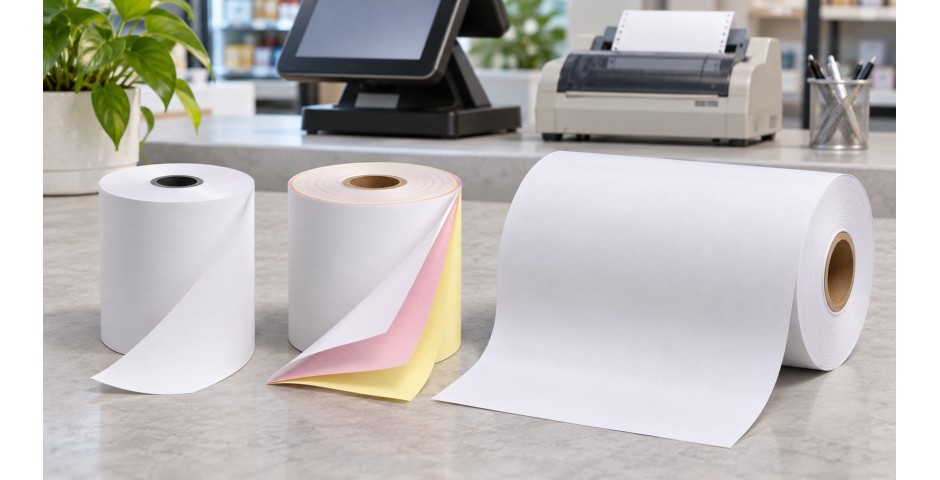
NCR stands for "No Carbon Required." Carbonless paper makes copies without the messy black carbon sheets people used decades ago. Instead, it uses tiny capsules of dye and a special clay coating.
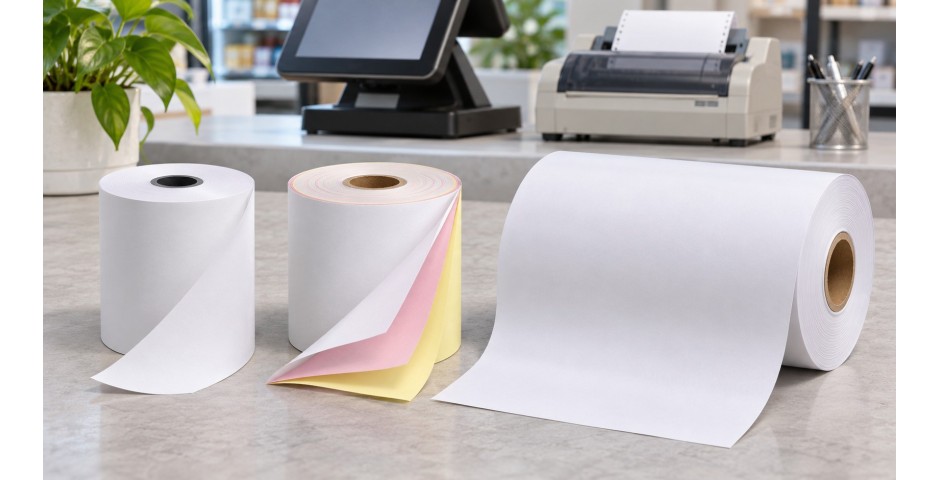
A carbonless set has layers that work together:
- CB (Coated Back): the top sheet. Its back is coated with tiny dye capsules.
- CFB (Coated Front and Back): the middle sheet. It receives a copy on the front and passes one on from the back.
- CF (Coated Front): the bottom sheet. It only receives the copy.
When a pen or printer pin presses down on the top sheet, the capsules burst. The dye touches the clay on the sheet below and a copy appears. A 2-ply roll gives you an original and one copy. A 3-ply roll gives you an original and two copies.
Where it is used
- Impact (dot matrix) receipt printers
- Older cash registers that print with a ribbon
- Kitchen printers in hot restaurant kitchens, where some owners prefer impact printing over heat-sensitive paper
- Delivery dockets and order slips where one copy goes to the customer and one stays with you
What to remember
Carbonless rolls need an impact printer, which presses pins against the paper. They will not work properly in a thermal printer, because a thermal printer uses heat, not pressure. Carbonless paper also does not work well in most inkjet or laser printers.
The big advantage of NCR is that it creates instant duplicates. If your business needs signed copies or a paper trail, NCR is still the easiest way to get one.
Fax Paper Rolls
Fax paper rolls are thermal paper too. They are just made in wider widths to fit older thermal fax machines. They use the same heat-sensitive coating, so they also fade over time.
Most modern offices now use plain paper fax machines or send faxes through email. But many clinics, government offices, factories and logistics companies in Malaysia still run older thermal fax machines. If yours is one of them, you need the right fax roll width. Check the label inside the paper compartment or the user manual.
Because fax paper fades, photocopy or scan any fax you need to keep. This is especially important for signed documents, purchase orders and contracts.
Thermal vs Carbonless vs Fax: Side by Side
| Feature | Thermal | Carbonless (NCR) | Fax roll |
|---|---|---|---|
| How it prints | Heat | Pressure | Heat |
| Ink or ribbon needed? | No | Usually a ribbon | No |
| Makes copies? | No | Yes, 2-ply or 3-ply | No |
| Fades over time? | Yes | Much less | Yes |
| Typical machine | POS printer, card terminal | Dot matrix or impact printer | Thermal fax machine |
How to Read Roll Sizes
Paper rolls are described with three measurements. Getting any one of them wrong can mean the roll will not fit.
- Width. This is how wide the paper strip is. The two most common receipt widths are 80 mm, used in standard countertop POS printers, and 57 mm (sometimes sold as 58 mm), used in card terminals and small portable printers.
- Roll diameter. This is how wide the whole roll is from edge to edge. A bigger diameter means more paper, but the roll must still fit inside the printer's compartment.
- Core size. This is the size of the hole in the middle. A 12.7 mm (half inch) core is common for many receipt printers, but some machines need a different core.
So when you see a roll labelled "80 x 80 mm," it usually means 80 mm wide with an 80 mm outer diameter. The easiest way to order correctly is to measure your current roll or note the numbers printed on its box.
Buying Tips
- Check the printer type first. Thermal printer? Buy thermal rolls. Impact printer? Buy plain bond or carbonless rolls.
- Test for thermal paper. Scratch the paper quickly with your fingernail. If a dark mark appears, it is thermal.
- Store rolls properly. Keep spare rolls in their packaging, away from sunlight and heat. Malaysia's heat and humidity can shorten the life of thermal paper on the shelf.
- Buy by the box. Rolls run out at the worst moments, like the middle of a lunch rush. Keep a spare box in stock.
- Think about records. If you must keep receipts for audits, consider a digital backup or a carbonless system for your copies.
Order the Right Rolls from paper.com.my
At paper.com.my, we supply thermal rolls, carbonless (NCR) rolls, fax rolls and high white rolls for businesses across Malaysia. Whether you run a café, a retail shop, a clinic or a warehouse, we can help you find the right width, diameter and core size for your machine.
Not sure which roll your printer uses? Send us a quote request with your printer brand and model, or a photo of your current roll. We will match it for you, so your next order fits the first time.
In Same Category
- Copier Paper GSM Guide: 70gsm vs 80gsm and Why It Matters for Jams and Print Quality
- Continuous Computer Forms: 9.5" x 11" vs 15" x 11", and When You Still Need Them
- Paper Sizes Explained: A4, A3, A5, B4, B5 and F4. Which One Does Your Office Actually Need?
- Pizza Kotak Guide: Choosing the Right Pizza Box Size, Material and Print for Your F&B Business
- The Complete Packaging Supplies Checklist for Malaysian Online Sellers