
Paper Sizes Explained: A4, A3, A5, B4, B5 and F4. Which One Does Your Office Actually Need?
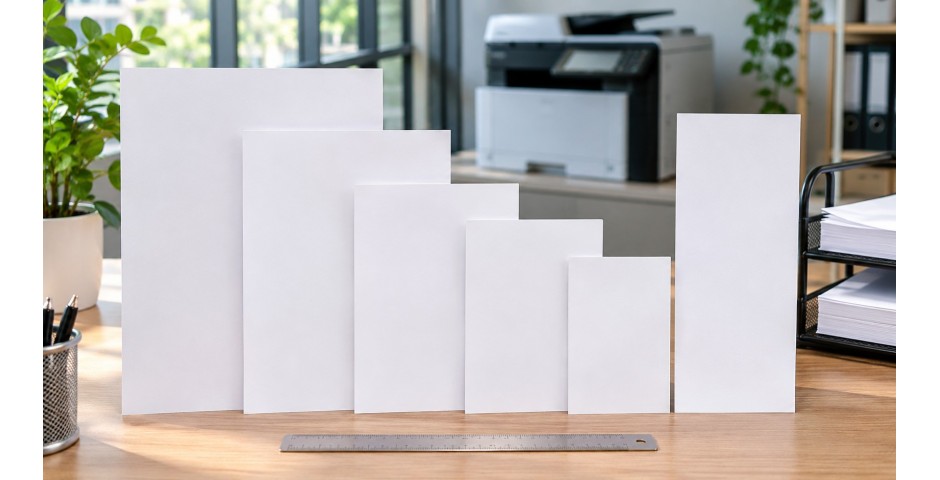
Walk into any office supply store and you will see stacks of copier paper with labels like A4, A3, B5 and F4. Most people grab A4 and move on. That works fine most of the time. But sooner or later someone needs to print a large spreadsheet, a government form or a booklet, and suddenly A4 is the wrong choice.
This guide explains what each common size means, how big it really is, and when you should use it. By the end, you will know exactly which paper to keep in your supply cabinet.
Most of the world, including Malaysia, uses the ISO 216 standard for paper sizes. Malaysia adopted it as a national standard too, under the name MS ISO 216. The system is clever. Every sheet in a series has the same shape, so you can enlarge or shrink a page without cutting off any edges.
Walk into any office supply store and you will see stacks of copier paper with labels like A4, A3, B5 and F4. Most people grab A4 and move on. That works fine most of the time. But sooner or later someone needs to print a large spreadsheet, a government form or a booklet, and suddenly A4 is the wrong choice.
This guide explains what each common size means, how big it really is, and when you should use it. By the end, you will know exactly which paper to keep in your supply cabinet.
Why Paper Sizes Have Letters and Numbers
Most of the world, including Malaysia, uses the ISO 216 standard for paper sizes. Malaysia adopted it as a national standard too, under the name MS ISO 216. The system is clever. Every sheet in a series has the same shape, so you can enlarge or shrink a page without cutting off any edges.
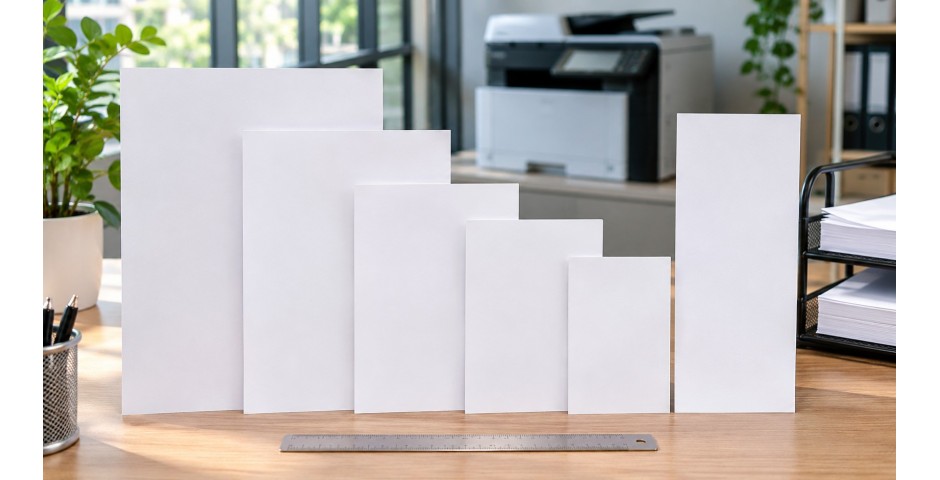
Here is how it works. Start with A0, which is a big sheet of about one square metre. Fold it in half and you get A1. Fold A1 in half and you get A2. Keep going and you reach A4, the size you use every day. So a bigger number always means a smaller sheet.
The B series follows the same rule, but each B sheet is a little larger than the A sheet with the same number. That is why B4 sits between A4 and A3 in size.
Quick Size Chart
| Size | Millimetres | Inches (approx.) | Common uses |
|---|---|---|---|
| A3 | 297 x 420 mm | 11.7 x 16.5 in | Charts, posters, wide spreadsheets, drawings |
| B4 | 250 x 353 mm | 9.8 x 13.9 in | Newsletters, exam papers, larger forms |
| F4 | 210 x 330 mm | 8.3 x 13 in | Legal papers, longer forms, some official documents |
| A4 | 210 x 297 mm | 8.3 x 11.7 in | Letters, reports, invoices, everyday printing |
| B5 (ISO) | 176 x 250 mm | 6.9 x 9.8 in | Notebooks, books, workbooks |
| A5 | 148 x 210 mm | 5.8 x 8.3 in | Flyers, booklets, notepads, receipts |
One note on B5. There are two versions. The ISO B5 is 176 x 250 mm, while the Japanese JIS B5 is a bit bigger at 182 x 257 mm. Many notebooks sold in Asia use the JIS version, so check the label if the exact size matters to you.
A4: The Everyday Workhorse
A4 is the default for almost everything in a Malaysian office. Letters, quotations, invoices, reports and school assignments all print on A4. Every home and office printer is built around it.
If you only stock one size, make it A4. But don't confuse it with US Letter. Letter paper is slightly wider and shorter than A4. If you download a template from an American website, your printer may shrink the page or cut off the bottom. Always set your document to A4 before you print.
A3: When You Need More Space
A3 is exactly two A4 sheets placed side by side. That makes it perfect for wide spreadsheets, floor plans, project timelines and simple posters. Architects, engineers and teachers use it a lot.
Not every printer can handle A3, though. Most small desktop printers only take A4. Large office copiers usually have an A3 tray. Before you buy a carton of A3 paper, check your machine.
Here is a handy trick. Because A3 and A4 have the same shape, you can shrink an A3 page to fit on A4 using the 71% setting on most copiers. To blow an A4 page up to A3, use 141%. Nothing gets cut off.
A5: Half of A4
A5 is what you get when you fold an A4 sheet in half. It is great for flyers, small booklets, menus, notepads and simple receipts. Many shops print A5 flyers because they are cheap to produce and easy to hand out.
You can also print two A5 pages on one A4 sheet and cut it down the middle. This saves time when you only need a few copies. If you print in bulk, buying ready-cut A5 paper is cleaner and faster.
B4 and B5: The In-Between Sizes
B sizes fill the gaps between the A sizes. B4 is a bit larger than A4 but smaller than A3. Schools often use it for exam papers because it gives students more writing space without being awkward to handle. Most office copiers support B4 alongside A4 and A3.
B5 is very popular for books and notebooks. It feels more comfortable to hold than A4 and still gives enough room to write. If you are printing a training manual or a workbook, B5 is worth a look.
Copiers have shortcut buttons for B sizes too. Reducing B4 to A4 uses about 84%. Enlarging B5 to A4 uses about 119%.
F4: The Long One
F4 is not part of the official ISO family, but it is very common in Southeast Asia. It is 210 x 330 mm. That means it has the same width as A4 but is about 3 cm longer. People often call it foolscap or folio.
Why would you need it? Some legal documents, agreements and older official forms are designed for F4. The extra length lets more text fit on a single page. If you deal with lawyers, government offices or certain accounting forms, keep a pack of F4 nearby.
One thing to watch. Not all printers can feed 330 mm paper from the main tray. You may need to slide the paper guide all the way out or use the manual feed slot. Also, set a custom paper size in your print settings so the printer knows what to expect.
How to Choose the Right Size
Ask yourself three simple questions before you buy.
- What are you printing most? For letters, invoices and reports, A4 covers most of the work. Add other sizes only when you have a clear need.
- What can your printer handle? Check the tray and the manual. A3 and F4 need a printer that supports them.
- Who will read it? Clients and government offices may expect a certain size. If a form says F4, print it on F4.
A practical setup for most small offices looks like this. Keep plenty of A4. Add a ream or two of A3 if your copier supports it. Keep a small stock of F4 if you handle legal or official forms. Schools and printing shops will usually want B4 and B5 as well.
Common Mistakes to Avoid
- Printing a Letter-size file on A4 without checking. The margins shift and text can get cut off. Change the page setup first.
- Loading F4 into a tray that is set to A4. The printer will think the page is shorter and may jam or leave a blank strip.
- Buying A3 for a printer that only takes A4. It happens more often than you would think. Check before you order.
- Mixing ISO B5 and JIS B5. The difference is small, but it matters for binders, covers and pre-printed forms.
Paper Weight Matters Too
Size is only half the story. Paper also comes in different weights, measured in GSM (grams per square metre). Everyday copier paper is usually 70 or 80 GSM. Heavier paper feels more premium and stops text from showing through the back. We cover this in more detail in our guide to copier paper GSM.
Get All Your Paper Sizes in One Place
At paper.com.my, we stock copier paper in A3, A4, A5, B4, B5 and F4, so you don't have to shop around for each size. Whether you run a busy office, a school, a printing shop or a home business, you can order the exact sizes you need and get them delivered together.
Not sure which size or weight fits your printer? Send us a quote request with your printer model and what you plan to print. We will help you pick the right paper so you spend less time fixing jams and more time getting work done.
In Same Category
- Copier Paper GSM Guide: 70gsm vs 80gsm and Why It Matters for Jams and Print Quality
- Continuous Computer Forms: 9.5" x 11" vs 15" x 11", and When You Still Need Them
- Thermal vs Carbonless (NCR) vs Fax Paper Rolls: A Buyer's Guide for Malaysian Businesses
- Pizza Kotak Guide: Choosing the Right Pizza Box Size, Material and Print for Your F&B Business
- The Complete Packaging Supplies Checklist for Malaysian Online Sellers