


Standard Pallet Sizes in Malaysia: Dimensions, Load Ratings and Container Fit
Pallets are one of those things nobody thinks about until the wrong size turns up at the loading bay. Then suddenly it matters a great deal, because the racking does not accept it, the forklift operator is grumbling, and half a container’s worth of space is going to waste.
This guide covers the pallet sizes you will actually come across in Malaysia, how to read load ratings without getting misled, and how pallet choice affects what you can fit into a shipping container.
Pallets are one of those things nobody thinks about until the wrong size turns up at the loading bay. Then suddenly it matters a great deal, because the racking does not accept it, the forklift operator is grumbling, and half a container’s worth of space is going to waste.
This guide covers the pallet sizes you will actually come across in Malaysia, how to read load ratings without getting misled, and how pallet choice affects what you can fit into a shipping container.
There Is No Single “Standard” Pallet
The first thing to understand is that “standard pallet size” depends entirely on where your goods are going. The international standard ISO 6780 recognises six different footprints, and each one is associated with a particular region.
| Dimensions (mm) | Dimensions (inches) | Primary region |
|---|---|---|
| 1100 × 1100 | 43.30 × 43.30 | Asia |
| 1000 × 1200 | 39.37 × 47.24 | Europe, Asia |
| 800 × 1200 | 31.50 × 47.24 | Europe (the Euro pallet) |
| 1067 × 1067 | 42.00 × 42.00 | North America, Europe, Asia |
| 1219 × 1016 | 48.00 × 40.00 | North America (the GMA pallet) |
| 1165 × 1165 | 44.88 × 44.88 | Australia |
ISO 6780 footprint data as compiled by ICD Vietnam.
For Malaysian operations, the two you will meet most often are the 1100 × 1100 mm Asian footprint and the 1200 × 1000 mm size. The 1100 × 1100 is squarish, which suits container loading in Asian trade lanes and works well with four way entry handling. The 1200 × 1000 turns up frequently in manufacturing and in trade with Europe and the Middle East.
If you are shipping to a customer in Europe, expect them to ask for 1200 × 800. If you are shipping to the United States, expect 1219 × 1016. Getting this wrong is expensive, because the receiving warehouse may charge you to re-palletise on arrival.
A practical note: many Malaysian factories also run non standard, made to order sizes because their product simply does not sit nicely on any ISO footprint. That is perfectly normal for domestic use. It only becomes a problem when the goods start crossing borders or entering a third party warehouse with fixed racking. Suppliers such as pallets.my build to custom dimensions as well as standard sizes, so the sensible approach is to standardise where you export and customise where you do not.
Reading Load Ratings Properly
This is where a lot of buyers get caught out. A pallet does not have one load capacity. It has three, and they are very different numbers.
Static load is the maximum weight the pallet can hold while sitting still on a flat, solid floor. This is always the biggest number, and it is the one suppliers like to quote in marketing material.
Dynamic load is the maximum weight the pallet can carry while being moved by a forklift or pallet jack. This is significantly lower than static load, because the pallet is flexing and the load is shifting.
Racking load, sometimes called shelf load, is the maximum weight the pallet can carry when supported only at its two ends, with nothing underneath the middle. This is always the smallest of the three, often dramatically so, and it is the number that matters if your goods go into selective pallet racking.
The rule to remember: always specify your requirement in racking load terms if the pallet will go on a rack. A pallet rated for a very high static load may bow alarmingly when unsupported in the middle.
Load capacity varies by construction, timber species, moisture content, deck board thickness and stringer or block design, so there is no universal figure to quote here. Ask your supplier for the specific static, dynamic and racking ratings for the exact pallet you are buying, and ask what those ratings are based on. A supplier who cannot give you all three numbers is guessing, and so are you.
Choosing the Material
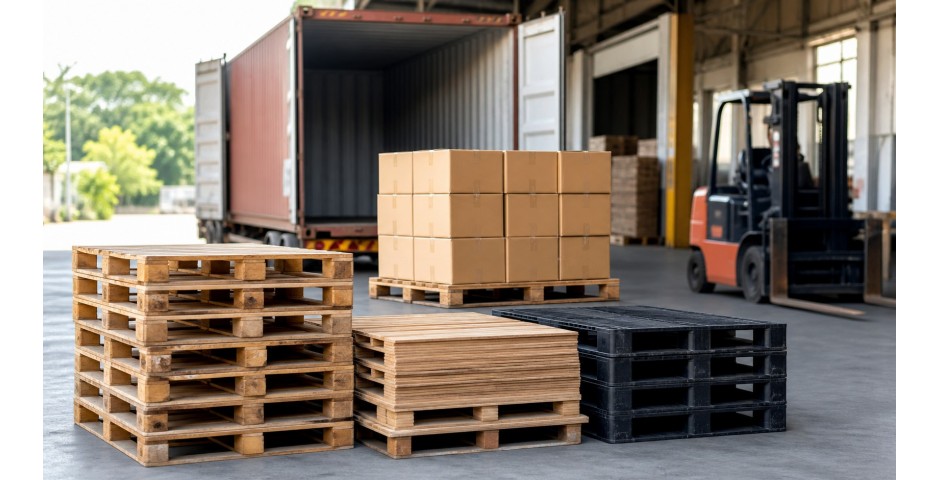
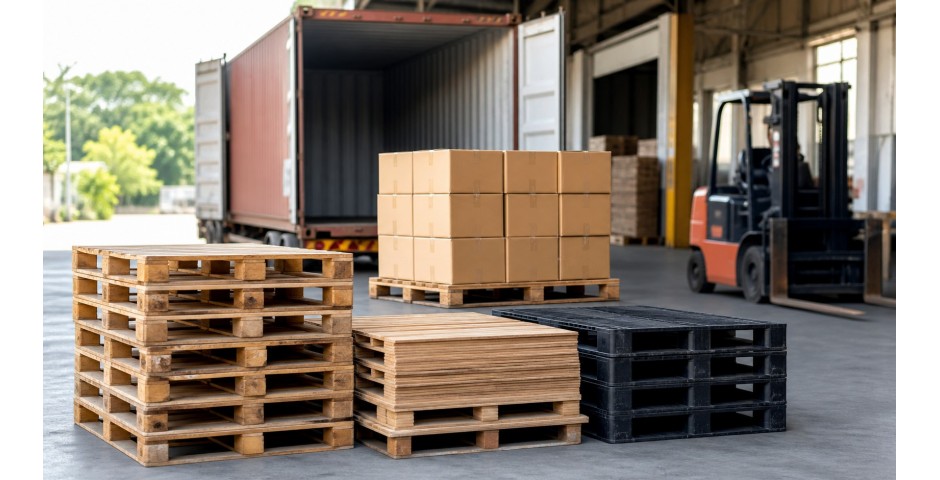
Wooden pallets are the workhorse. They are the most economical for one way and general domestic use, easy to repair, and available in almost any dimension. Standard two way and four way entry wooden pallets cover the majority of local warehouse and transport needs.
Plywood, pine and LVL pallets are lighter than solid hardwood, which reduces your chargeable freight weight on export shipments. They are also engineered for repeat use, which makes them a good middle option when you are shipping overseas regularly and want something better than a throwaway pallet.
Plastic pallets cost more upfront but last far longer, do not absorb moisture, and can be washed down. That makes them the natural choice for food processing, pharmaceutical and any environment with hygiene auditing. They are also exempt from timber treatment rules for export, which we will come to shortly.
Wooden crates and boxes are a separate category for machinery, spare parts and anything that needs full enclosure rather than a flat deck. If you are exporting heavy equipment, you are usually looking at a crate rather than a pallet.
You can see the full range of wooden, plywood, LVL and plastic pallets to compare specifications side by side.
Pallet Size and Container Fit
Here is where pallet dimensions turn directly into money. According to DSV, a standard dry container has these internal dimensions:
| Container | Internal L × W × H (mm) | Max payload |
|---|---|---|
| 20 ft dry | 5,900 × 2,350 × 2,390 | 25,000 kg |
| 40 ft dry | 12,030 × 2,350 × 2,390 | 27,600 kg |
DSV puts the practical loading at roughly 10 pallets in a 20 ft and around 20 to 24 pallets in a 40 ft, depending on footprint. Do note that DSV itself cautions that dimensions vary by container manufacturer, age and owner, so treat these as planning figures rather than gospel.
The important insight is the 2,350 mm internal width. Two pallets of 1100 mm sit side by side at 2,200 mm, leaving 150 mm of slack for handling. Two pallets of 1200 mm sit at 2,400 mm, which does not fit, so 1200 mm pallets have to be loaded in the other orientation. Getting this wrong is how a container ends up shipping half empty.
Before you commit to a pallet size, do the arithmetic for your actual container and your actual carton dimensions. It is a fifteen minute exercise that can change your freight cost per unit permanently.
Export Pallets and ISPM 15
If your pallets are leaving the country, solid wood packaging has to be treated and marked under ISPM 15.
The heat treatment requirement is that the wood must reach and hold 56 °C for at least 30 continuous minutes throughout the wood profile, as set out in the IPPC explanatory document for ISPM 15. The mark must carry the IPPC symbol, the ISO two letter country code, the treatment abbreviation such as HT, and the control number of the approved facility. It must be permanent and legible, and it cannot be hand drawn.
In Malaysia, the scheme is administered by the Department of Agriculture through the Federal Crop Protection and Plant Quarantine Office as the National Plant Protection Organisation, with the Plant Quarantine Divisions handling Sabah and Sarawak. The Department of Agriculture’s wood packaging manual sets out the marking format using the MY country code together with the company number and the HT designation, and describes the audit and certification process for treatment providers.
Two useful exemptions to know. Wood thinner than 6 mm is outside the scope, and processed materials such as plywood, oriented strand board and fibreboard are excluded because the manufacturing process already removes the pest risk. This is precisely why plywood and LVL pallets are popular for export, and why plastic pallets sidestep the question altogether.
A Short Checklist Before You Order
- Confirm the destination market and its expected pallet footprint.
- Measure your carton and work out the best stacking pattern on that footprint.
- Decide the material based on hygiene needs, reuse cycles and freight weight.
- Ask for static, dynamic and racking load ratings, all three.
- Check your racking beam spacing and your forklift entry type, two way or four way.
- Confirm ISPM 15 treatment and marking if the shipment is going overseas.
- Run the container fit calculation before you place the order, not after.
Getting Advice on Your Specific Case
Pallet selection is one of those decisions that looks trivial and then quietly shapes your logistics costs for years. If you are unsure which footprint suits your product and your export lanes, it is worth talking it through with a manufacturer rather than picking from a catalogue.
Pallet supplier in Malaysia Pallets.my manufactures wooden, plywood, pine, LVL and plastic pallets along with wooden crates and cable drums, works to custom dimensions as well as standard sizes, and is based in the Klang Valley with delivery arranged across all Malaysian states including Sabah, Sarawak and Labuan.
In Same Category
- How to Choose a Carton Box Supplier in Malaysia: A Practical Buyer’s Checklist
- How to Choose the Right Packaging Box for Your Product
- Importance of Print Resolution and Image Quality in Paper Printing
- Paper Printing for Packaging and Product Labeling
- The Enduring Role of Paper in Education and Learning